
PFAS in Clothing: French 2026 Regulations and Textile Solutions for Brands
Since January 1st, 2026, France has significantly strengthened its regulation of PFAS in several consumer products, including clothing textiles and footwear. For brands, distributors, promotional agencies and companies producing custom garments, this change marks an important turning point: chemical compliance must now be anticipated from the very beginning of the sourcing process.
Long used in certain technical finishes for their water-repellent, stain-resistant or grease-resistant properties, PFAS are now at the center of environmental and regulatory concerns. In the textile industry, this particularly affects outdoor clothing, parkas, softshell jackets, professional workwear, footwear and products treated with waterproofing agents.
What are PFAS?
PFAS, or per- and polyfluoroalkyl substances, are a large family of chemical substances that have been used for decades in many industrial sectors. They are valued for their resistance to water, grease, stains and heat.
The issue is that these substances are highly persistent in the environment. This is why they are often referred to as “forever chemicals”. According to ANSES, PFAS are used in many applications, including textiles, packaging, firefighting foams, cosmetics and certain technical coatings.
In textiles, PFAS may be present in certain treatments applied to fabrics in order to improve their performance: water repellency, stain resistance, oil resistance or protection against certain liquids.
Why are PFAS relevant to clothing?
Not all garments are affected in the same way. A basic cotton T-shirt or a sweatshirt without any technical treatment generally presents a lower risk than a water-repellent jacket, a parka or an outdoor garment.
The most sensitive products are those requiring a functional finish: water-repellent, stain-resistant, oil-repellent, waterproof, easy-care or technical coating treatments.
| Product type | Level of vigilance |
|---|---|
| Water-repellent jackets | High |
| Parkas and softshell jackets | High |
| Outdoor garments | High |
| Treated footwear | High |
| Aprons or stain-resistant garments | Medium to high |
| Professional uniforms with technical finishing | Medium to high |
| T-shirts, polo shirts and sweatshirts without specific treatment | Lower |
| Treated textile accessories | Variable |
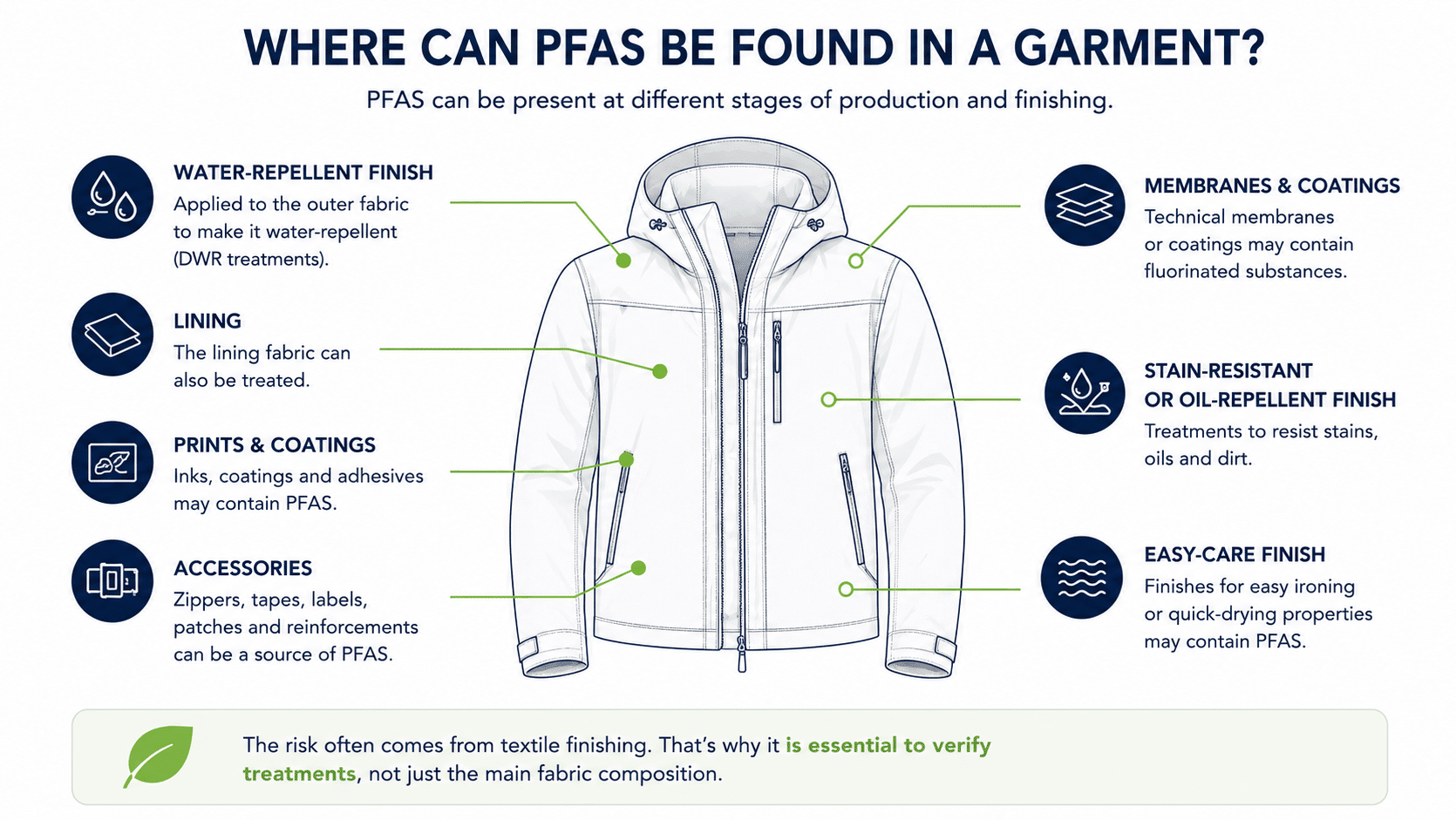
In practice, the risk often comes from the textile finish. For a brand, it is no longer enough to validate only the main fabric composition. Treatments applied after weaving, dyeing or printing must also be checked.
What does the French 2026 regulation say?
From January 1st, 2026, French regulation prohibits the manufacture, import, export and placing on the market of several product categories containing PFAS above defined thresholds. The products concerned include clothing textiles, footwear, cosmetics, ski waxes and waterproofing agents.
For clothing, the regulatory thresholds are particularly strict:
| French 2026 requirement | Applicable limit |
|---|---|
| Individual targeted PFAS | 25 ppb |
| Sum of targeted PFAS | 250 ppb |
| PFAS including polymers | 50 ppm |
These thresholds are also consistent with information communicated by textile testing laboratories: 25 ppb for any individual PFAS and 250 ppb for the sum of targeted PFAS, with a list of substances including PFOS, PFOA, PFHxS, PFHxA and several related substances.
The regulation provides for certain exemptions, particularly for technical textiles for industrial use, certain personal protective equipment, products intended for the armed forces, internal security or civil protection, as well as clothing textiles and footwear incorporating at least 20% post-consumer recycled material, under specific conditions.
Official source:
Decree No. 2025-1376 of December 28, 2025 and
French Environmental Code.
“PFAS-free”: why a simple supplier declaration is not always enough
Since these new requirements came into force, more and more suppliers have started offering “PFAS-free” or “no intentionally added PFAS” fabrics. This is an important first step, but such a declaration is not always enough to guarantee the compliance of a finished product.
A garment is made of several components:
| Garment component | Control point |
|---|---|
| Main fabric | Composition, finishing, water-repellent treatment |
| Lining | Possible treatment |
| Coating or membrane | Possible presence of fluorinated substances |
| Prints | Inks, binders, additives |
| Accessories | Zippers, patches, tapes, reinforcements |
| Final treatment | Water repellency, stain resistance, easy-care finish |
The risk may come from a treatment applied upstream, sometimes by a fabric supplier or finishing subcontractor, without the final garment manufacturer having complete visibility. This is why compliance should be secured through a combination of supplier documentation, material selection and, when necessary, laboratory testing.
Recent technical documents from specialized laboratories also remind brands that French PFAS requirements have been integrated into certain textile standards, but that certificates issued before the full application of the French thresholds should not automatically be considered sufficient. For the French market, an approach combining total fluorine screening and targeted PFAS testing may be necessary.
Need to develop garments compliant with the new PFAS requirements?
Textifab supports brands, agencies and companies in sourcing, developing and producing custom garments with no intentionally added PFAS, including supplier documentation review and laboratory testing when required by the target market.
What does a C0 finish mean?
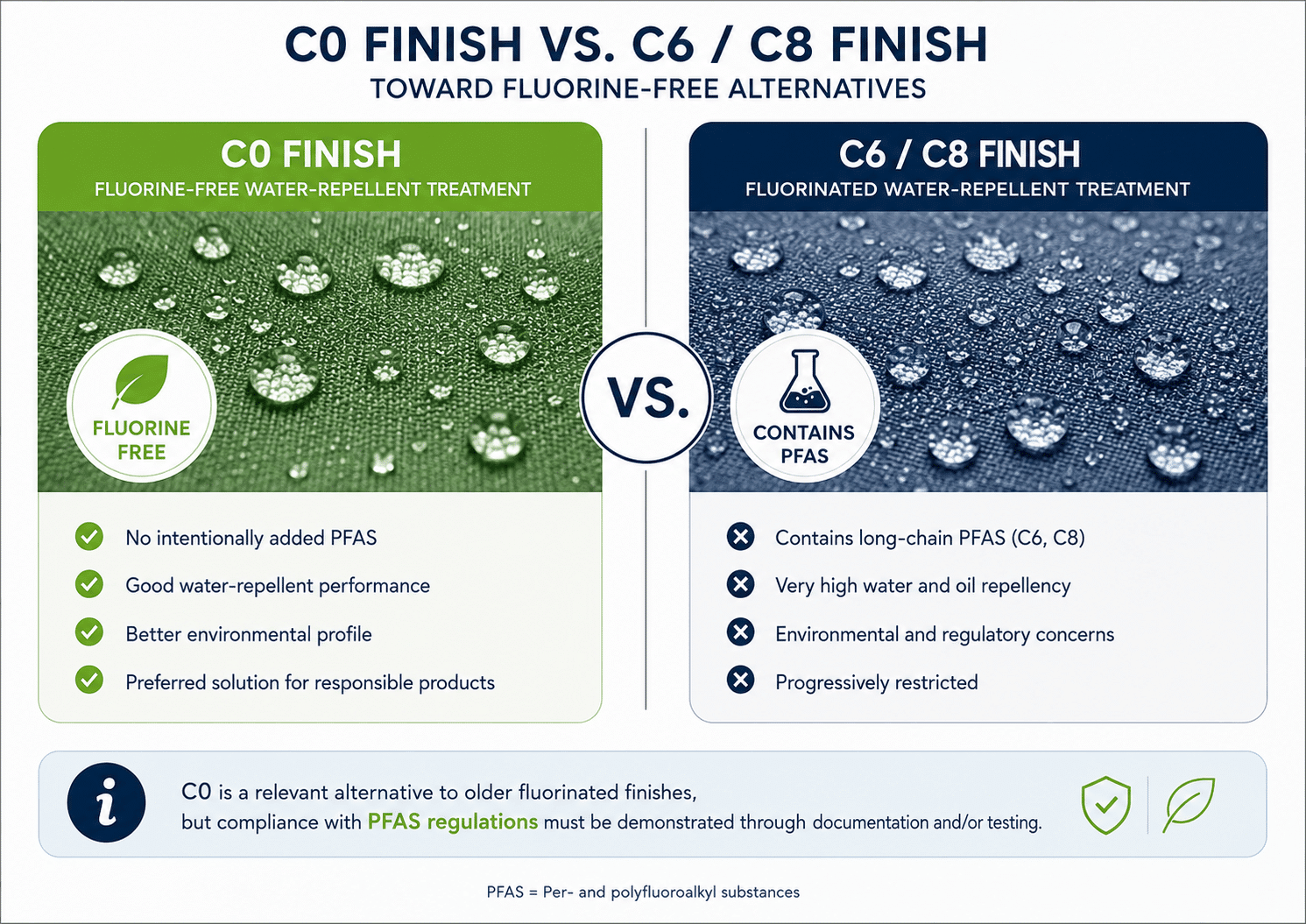
In the textile industry, suppliers often refer to C0 finishing, especially for water-repellent fabrics. A C0 finish generally refers to a fluorine-free water-repellent treatment, developed as an alternative to older fluorinated finishes such as C6 or C8.
C0 treatments can provide good water repellency on many products: jackets, softshells, parkas, outdoor garments, textile accessories or professional uniforms. They are now a preferred solution for developing garments without intentionally added PFAS.
However, caution is still necessary: C0 should not be presented as an automatic guarantee of compliance with French PFAS regulations. A C0 finish significantly reduces the risk associated with fluorinated treatments, but it should be supported by clear supplier documentation and, where necessary, testing adapted to the French market.
A C0 finish is a relevant alternative for developing water-repellent garments without intentionally added PFAS, subject to documentation review and/or laboratory testing depending on the target market.
What are the alternatives to PFAS treatments?
Alternatives to fluorinated treatments are developing quickly. For brands, the challenge is to find the right balance between product performance, regulatory compliance and environmental expectations.
| Alternative | Main use | Point of attention |
|---|---|---|
| C0 finish | Water repellency | Oil resistance is generally more limited |
| Fluorine-free water-repellent treatment | Jackets, softshells, parkas | Wash durability should be checked |
| Denser textile construction | Mechanical protection against light rain | Does not always replace a true water-repellent finish |
| Suitable membrane or lamination | Technical garments | Chemical composition must be verified |
| Optimized fabric selection | Uniforms, professional garments | Depends on the final use |
Fluorine-free treatments can now provide good water-repellent performance. However, they do not always reproduce the same oil-repellent or grease-resistant performance as older fluorinated finishes. For workwear exposed to greasy splashes, the technical specifications should therefore be analyzed carefully.
Which tests should be requested for garments sold in France?
For products intended for the French market, the testing strategy should be adapted to the level of risk. A garment without a specific technical treatment will not necessarily require the same level of control as a water-repellent jacket or a stain-resistant professional textile.
| Test type | Purpose |
|---|---|
| Total fluorine | Screening method used to identify the potential presence of fluorinated substances |
| Targeted PFAS analysis | Verification of regulated PFAS and comparison with applicable thresholds |
For the French market, compliance cannot always rely on total fluorine testing alone. Total fluorine can be used as an indicator, but it should be supplemented by targeted PFAS analysis when regulatory compliance needs to be demonstrated.
In practice, brands can work with recognized laboratories such as Eurofins, SGS, Intertek, Bureau Veritas or Hohenstein to define the appropriate testing protocol for each product.
Which Textifab products are most concerned?
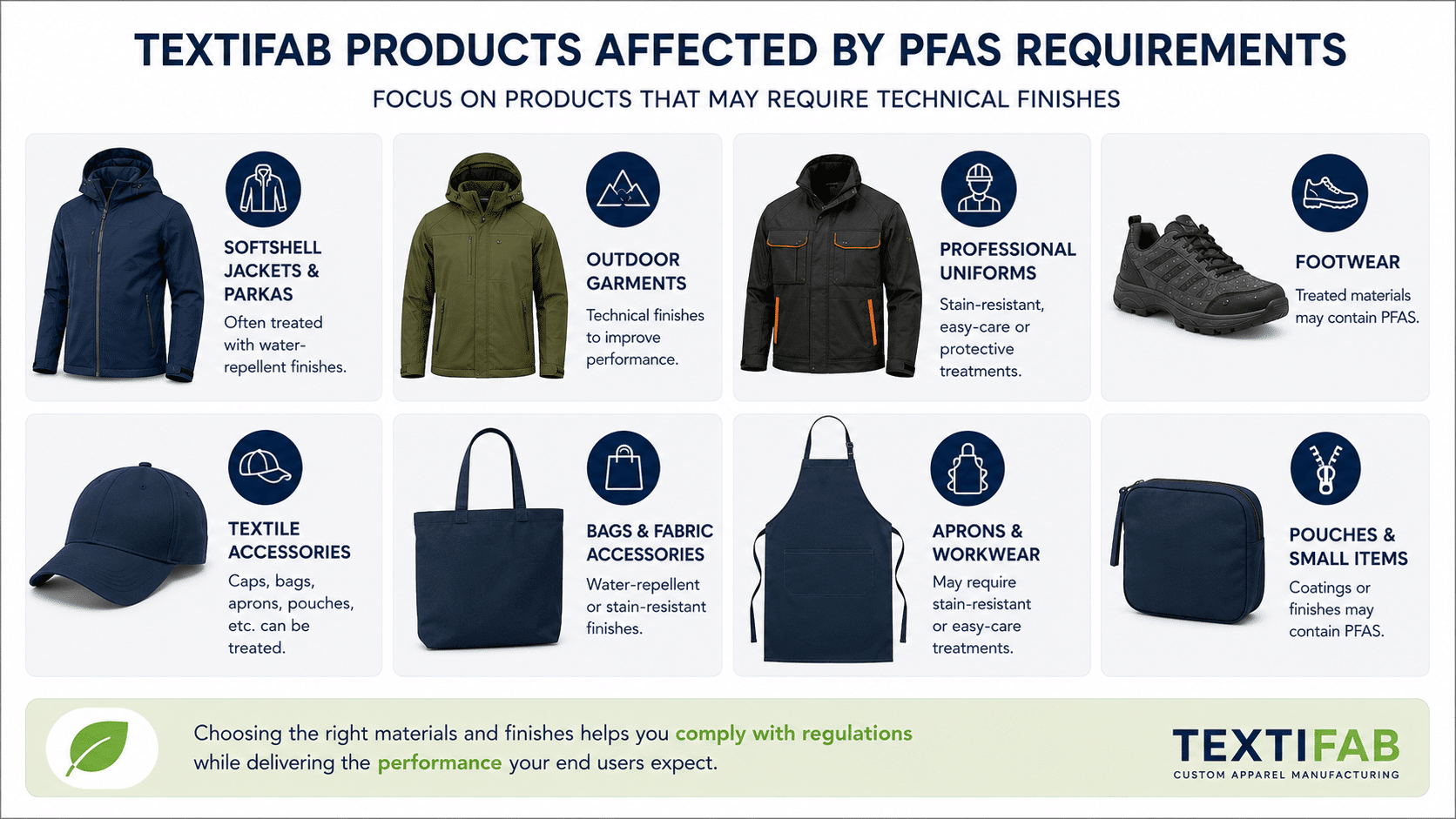
Custom softshell jackets, parkas and outdoor garments
Custom softshell jackets, parkas and outdoor garments are among the most concerned products because they may receive a water-repellent finish or include a technical membrane. For these products, Textifab can guide development toward solutions with no intentionally added PFAS, including C0 treatments or fluorine-free alternatives.
Professional garments and uniforms
Some custom professional garments require specific properties: stain resistance, easy-care performance, protection against splashes or outdoor use. In such cases, it is essential to verify the exact nature of the treatment applied to the fabric.
Custom T-shirts, polo shirts and sweatshirts
Custom T-shirts, polo shirts and sweatshirts without any specific technical treatment generally present a lower risk. However, vigilance remains necessary in the case of special printing, coating, easy-care finishing or functional treatment.
Textile accessories
Custom textile accessories, bags, caps, bucket hats, aprons, pouches or outdoor articles may also be concerned when they receive a water-repellent, stain-resistant or waterproofing finish.
How Textifab supports brands
For brands producing custom garments or textile accessories, PFAS compliance must be integrated from the start. Waiting until the end of production to test a product may lead to delays, additional costs or import issues.
Textifab supports clients at several stages:
| Stage | Textifab support |
|---|---|
| Need analysis | Identifying the performance level actually required |
| Fabric sourcing | Searching for fabrics suitable for the European market |
| Finishing selection | Guiding clients toward treatments with no intentionally added PFAS when possible |
| Documentation | Collecting technical data sheets, certificates and supplier declarations |
| Product development | Integrating compliance constraints from the specification stage |
| Laboratory testing | Coordinating with third-party laboratories when required |
| Production | Factory follow-up and quality control before shipment |
The objective is simple: helping brands combine product performance, regulatory compliance and CSR expectations, without making textile development unnecessarily complex.
For technical projects, Textifab can also support brands in the development of custom-made garments integrating performance, durability and European market compliance requirements.
Practical checklist before launching textile production in 2026
Before launching production for the French market, brands should include a PFAS checklist in their technical specifications.
| Question to ask | Why it matters |
|---|---|
| Does the product require a water-repellent or stain-resistant finish? | These are among the most sensitive uses |
| Does the supplier use a C0 finish? | This is a relevant alternative to fluorinated treatments |
| Is the “PFAS-free” declaration documented? | A simple commercial statement is not enough |
| Are the certificates recent? | Certificates issued before the new requirements may not cover the 2026 thresholds |
| Is the target market France? | French thresholds are particularly strict |
| Is laboratory testing necessary? | Recommended for technical or higher-risk products |
| Have accessories and prints been checked? | The risk does not only come from the main fabric |
This approach helps avoid unpleasant surprises and secure the product before placing it on the market.
FAQ: PFAS, clothing and French 2026 regulations
What does PFAS-free mean in textiles?
In textiles, “PFAS-free” generally means that the supplier declares that no PFAS have been intentionally used in the material or finish. This declaration should still be supported by clear documentation and, when necessary, laboratory testing.
Is a C0 finish automatically compliant with PFAS regulations?
No. A C0 finish is a fluorine-free alternative to older fluorinated finishes, but it should not be considered an automatic guarantee of compliance. For the French market, documentation review and/or laboratory testing may still be required.
Which garments are most affected by PFAS?
The most affected garments are products with water-repellent, stain-resistant, oil-repellent or waterproofing finishes: outdoor jackets, parkas, softshells, technical workwear, footwear and treated accessories.
Is an OEKO-TEX certificate enough to prove PFAS compliance?
A recent OEKO-TEX certificate can be a useful element, but it should not always be considered sufficient, especially for certificates issued before the full application of the new French limits. For technical products, additional checks may be necessary.
Which tests are used to check PFAS in clothing?
The most common tests are total fluorine screening and targeted PFAS analysis. Total fluorine helps identify a potential risk, while targeted analysis compares results with applicable regulatory thresholds.
Are PFAS-free water-repellent treatments as effective?
Fluorine-free treatments can now offer good water-repellent performance. However, they may be less effective than older fluorinated finishes for oil or grease resistance. The right choice depends on the final use of the garment.
Can Textifab produce garments with no intentionally added PFAS?
Yes. Textifab can guide clients toward materials, finishes and treatments with no intentionally added PFAS, depending on the specifications, target market and testing requirements.
Conclusion: toward a new textile standard
PFAS regulation marks a new step for the textile industry. Brands can no longer choose a fabric based only on price, appearance or technical performance. Chemical compliance must also be integrated into the sourcing strategy.
For technical garments, professional uniforms, outdoor jackets or treated accessories, choosing a fluorine-free finish, such as C0, is becoming an important solution. But this solution must be supported by documentation review and, where necessary, appropriate testing.
By integrating these requirements from the development stage, Textifab helps its clients create garments and textile accessories that meet the expectations of the French market while maintaining the performance level required by end users.